
Written by Phil Wala
1911 (June 4)
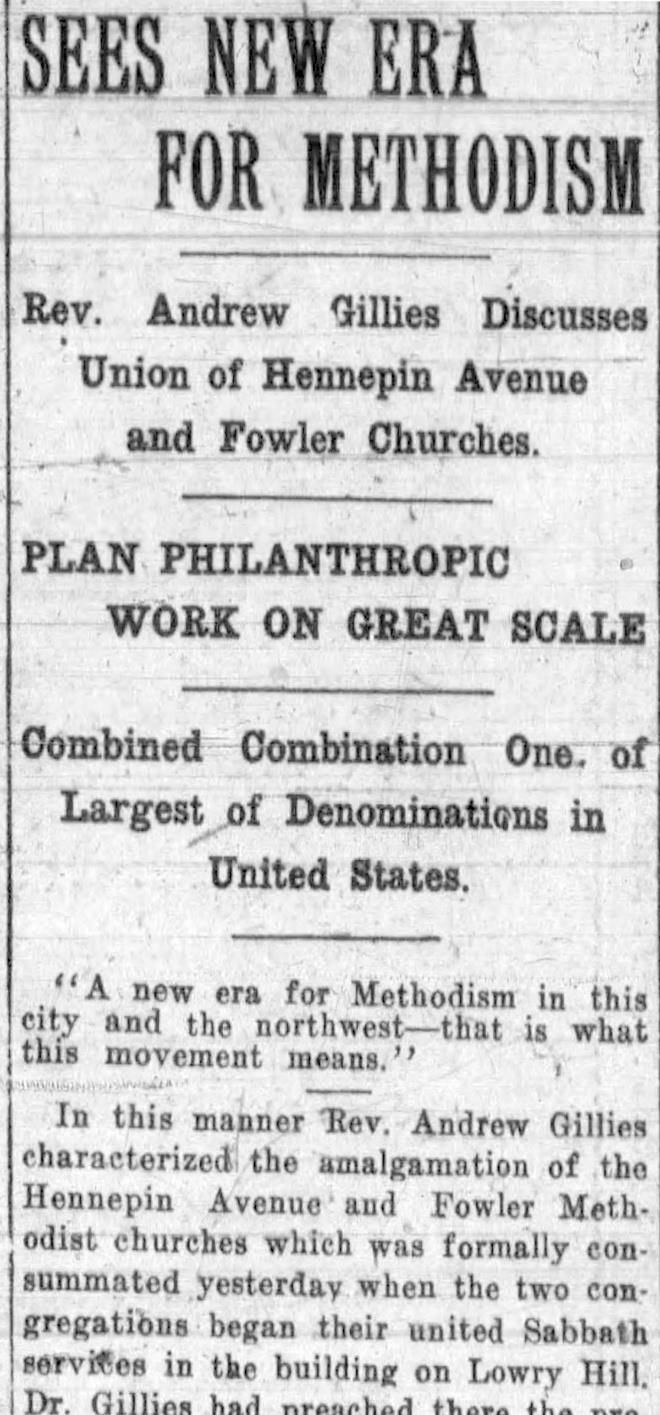
The Hennepin Avenue and Fowler Methodist churches hold their first joint service in the large sanctuary of the Fowler Methodist Church (now the Scottish Rite Temple). Although the church listing still refers to the Dupont and Franklin location as “Fowler,” the combined congregation will officially be “Hennepin Avenue Methodist Episcopal Church.”

1874 (June 7)
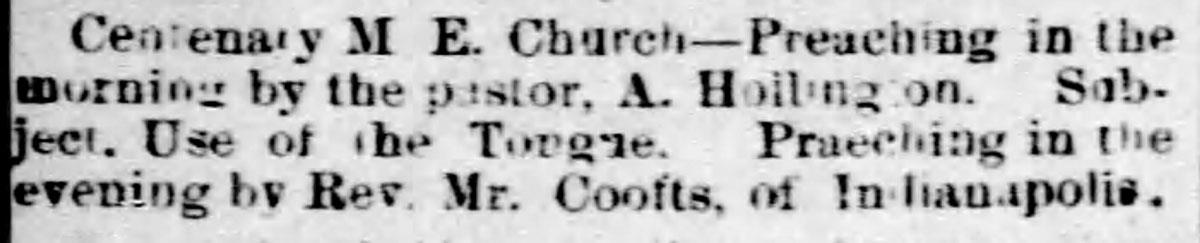
This tiny notice in the church listings of the Minneapolis Tribune announces that the pastor of Centenary Church, Rev. Ambrose Hollington, has chosen as his sermon topic, “Use of the Tongue.” It will be a pivotal sermon in the life of the church. A year-and-a-half later, that church would spawn a breakaway congregation, with Hollington himself as its first pastor. Read more about the significance of this particular sermon in the forthcoming book, Aspire! The 150-Year History of Hennepin Avenue United Methodist Church. (Minneapolis Tribune)
1877 (June 7)
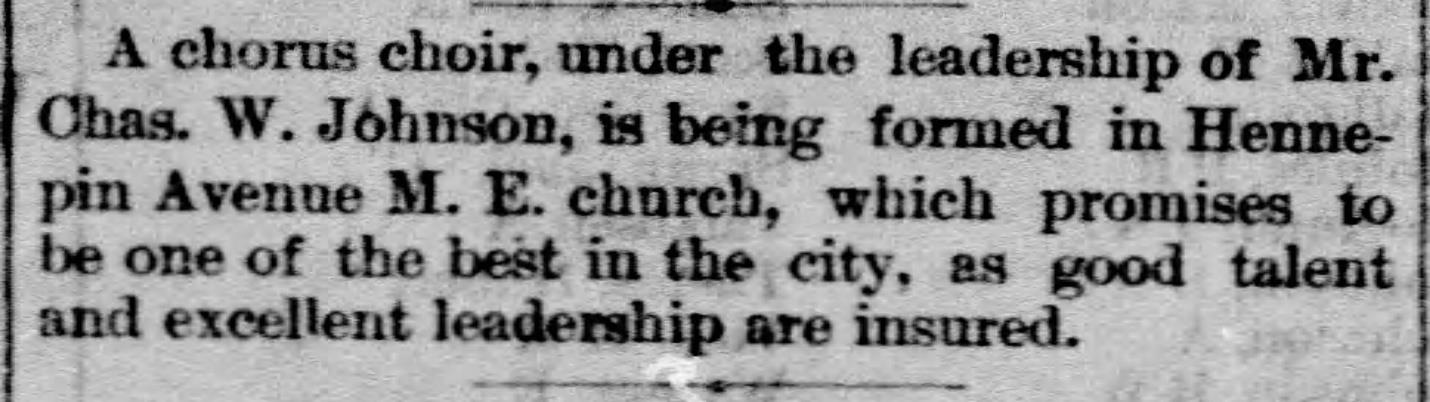
Hennepin Avenue United Methodist Church has been known throughout its history for the excellence of its music ministry, especially its choir. This is where it all started. One-and-a-half years after its founding, Hennepin Church is forming its first choir under the direction of Charles W. Johnson. (Minneapolis Tribune)
1877 (June 9)
The church’s first building is a wood-framed structure called the “Tabernacle.” In the Old Testament, the tabernacle was the “tent of meeting,” a temporary place of worship that the children of Israel carried with them as they wandered for forty years in the wilderness. And just like the one in the Old Testament, Hennepin Church considers their Tabernacle to be temporary (and, it turns out, even moveable). Members will meet to discuss whether it’s time to plan for a “permanent edifice” on the site of the old Jefferson School. (Minneapolis Tribune)

1891 (June 9)
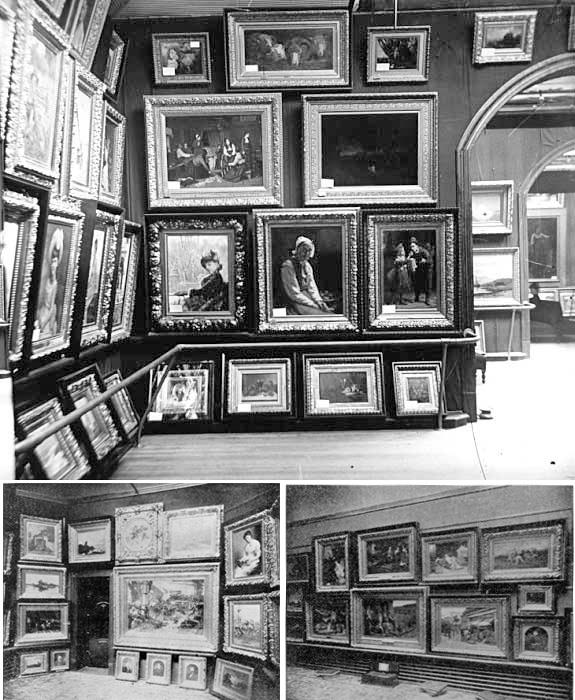
T. B. Walker and his wife Harriet are known for welcoming the public to the grounds of their home on the southeast corner of 8th and Hennepin.¹ They even put park benches on their lawn and invite anyone inside to view their private art gallery. After a period of remodeling, the gallery is once again open to the public. (Minneapolis Journal)
¹ currently the site of the State Theater

Here is a photo of the Walker home at 803 Hennepin Avenue. The art gallery is in the center, between the carriage house and the main residence.

Here are some views of the art gallery at the Walkers’ home on Hennepin Avenue.
1892 (June 8)
Hennepin Avenue Methodist Church hosts a meeting on the topic of women’s suffrage, and the church is filled to overflowing. (Minneapolis Times)

1910 (June 8)
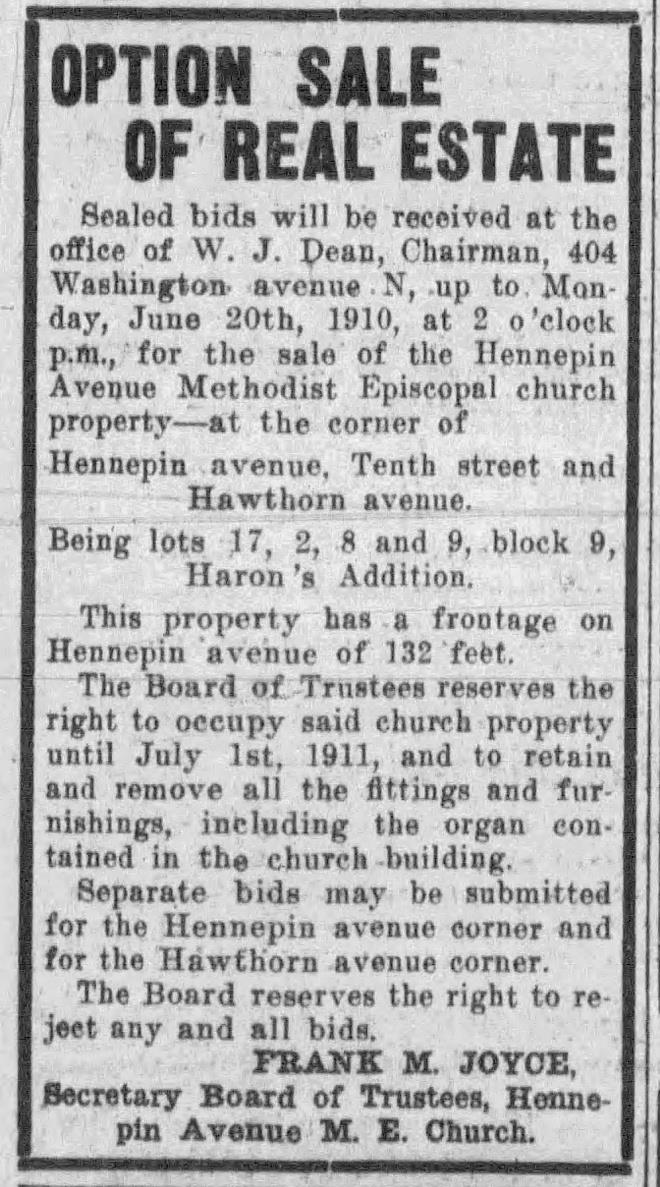
The church decides it will not reuse the 10th and Hennepin site for its new building. And although there has been no agreement on where they will build, the first step is to put their current building on the market. They figure that one year will be enough time for them to have built a new church and vacate their present site.¹
¹ The one-year estimate will prove to be off by about five years.
1911 (June 5)
The Minneapolis Journal takes note of yesterday’s first gathering of the combined Hennepin and Fowler congregations. Pastor Andrew Gillies proclaimed it as “a new era for Methodism.”
1915 (June 7)
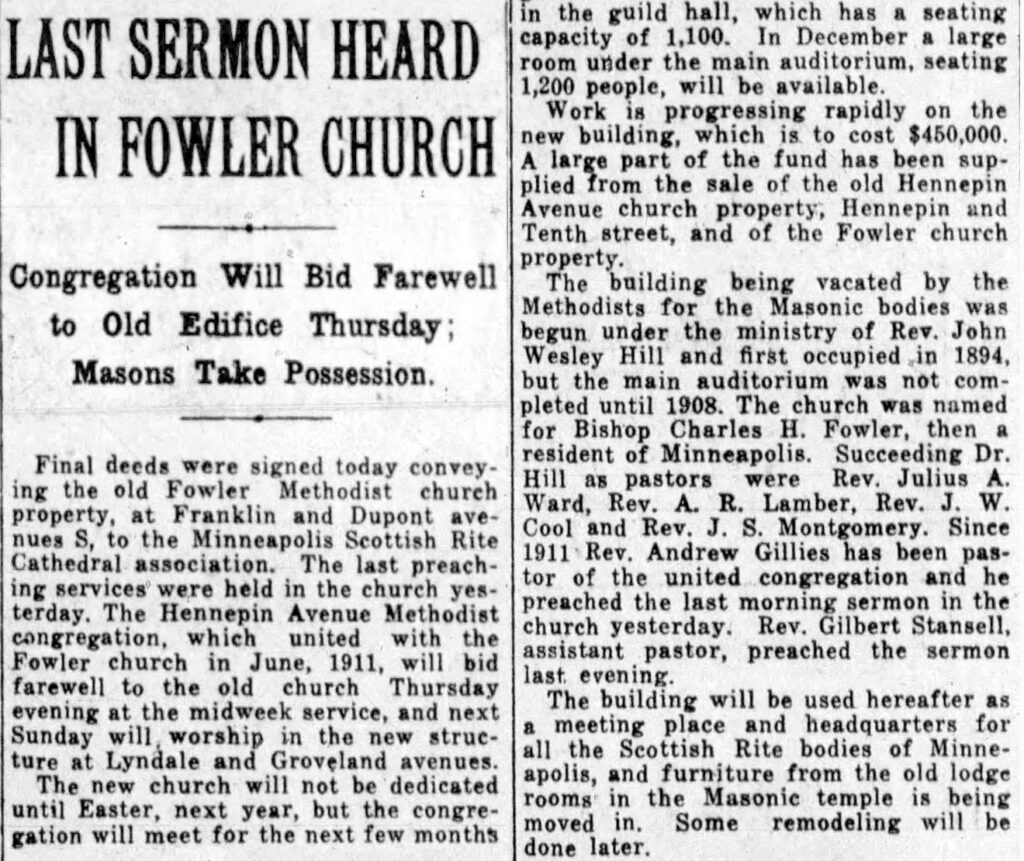
Deeds were signed transferring the former Fowler Church building at Franklin and Dupont to the Scottish Rite Masons. Next Sunday, Hennepin Avenue Church will meet for the first time in the new building at Groveland and Lyndale. Since the sanctuary isn’t yet ready, the Junior Assembly Room (the room now known as Carlson Hall) will be used as a temporary auditorium. The claimed seating capacity is 1,100. (Minneapolis Journal)
1918 (June 10)
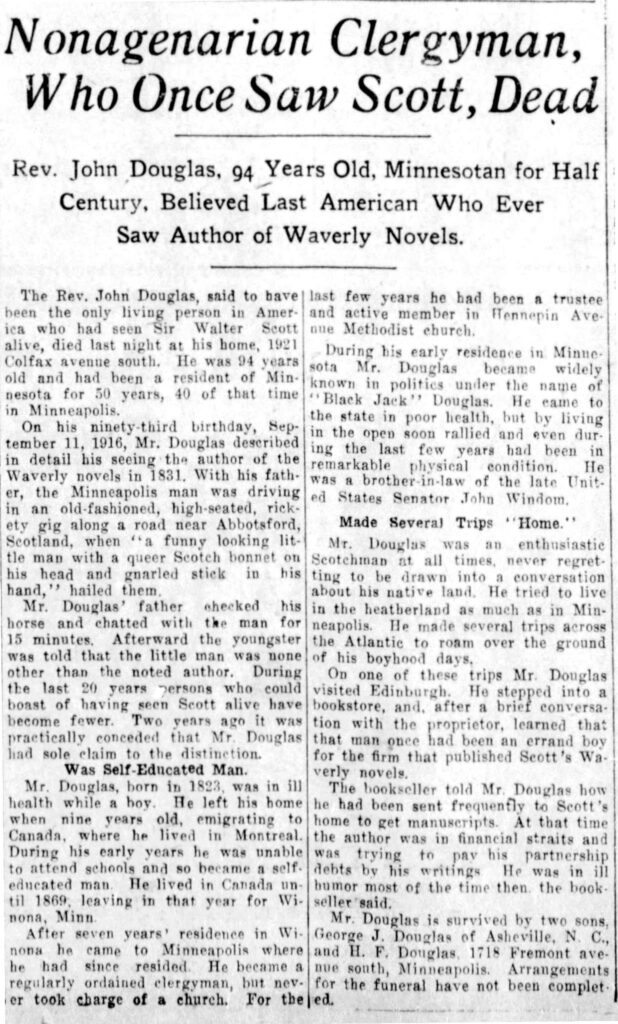
Rev. John Douglas, who helped organize Hennepin Avenue Church in 1875, has died at the age of 94. He was noted for being the last American alive to have seen Sir Walter Scott. He was also the brother-in-law of U.S. Senator from Minnesota, William¹ Windom.²
¹ the article mistakenly refers to him as “John”
² Senator William Windom was the great-grandfather of the actor who shares his name
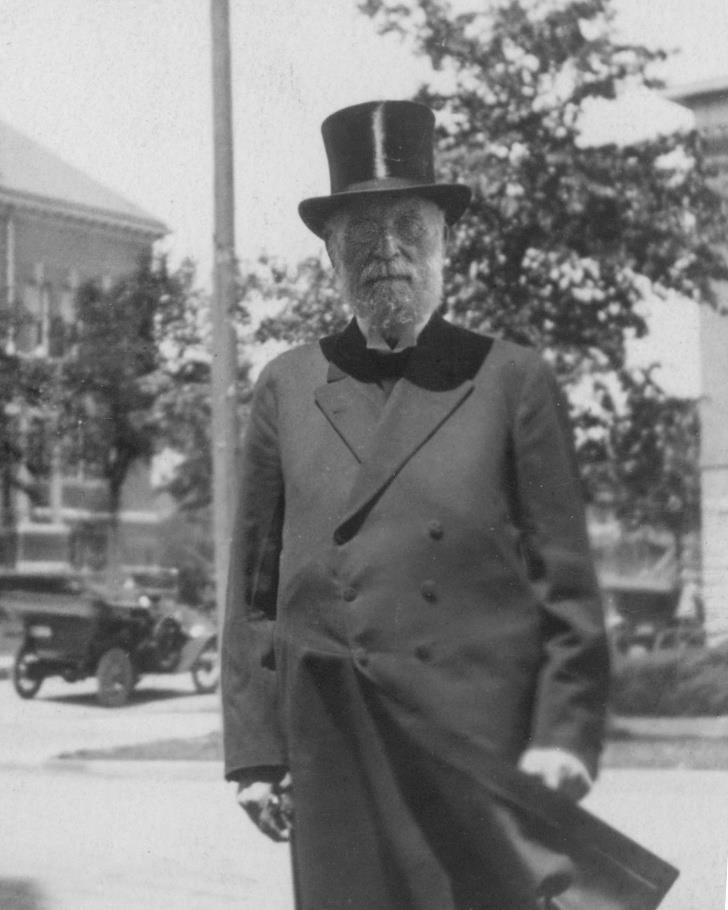
This snapshot of Rev. John Douglas was taken in 1912 by Elizabeth Wood Harrison and later donated to the church archives. Douglas would have been about 88 at the time.
Rev. Douglas’s brother-in-law U.S. Senator William Windom, and Windom’s great-grandson, the actor who shared his name.

2018 (June 10)
Rev. Sally Johnson retires, and the church celebrates her 33 years of ministry to the Hennepin community.
